
It is the rupee's biggest single-day gain this year.
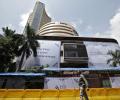
ONGC was the top performer while private banking major ICICI Bank extended gains
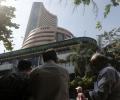
Financials emerged as the top gainers while auto shares rallied on robust September sales
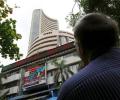
The S&P BSE Sensex ended 46 points lower at 24,824 and Nifty50 settled at 7,555, down by 8 points after hitting intra-day high of 7,600.45.
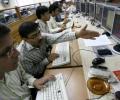
The 30-share Sensex closed down 115 points at 28,444 and the 50-share Nifty ended down 31 points at 8,524.

Growth in the eight core sectors jumped to 8.5% in April, due to a sharp pick-up in refinery products and a commensurate rise in electricity generation.
Adani Ports, HUL and L&T gained the most, while ICICI Bank, ONGC, GAIL and Tata Steel lost the most

Investor sentiment got a boost following remarks from the Russian President Putin that allayed fears of an imminent military conflict in Ukraine
L&T, ONGC and banking scrips power gains in today's trade

RBI's fifth bi-monthly monetary policy meet due tomorrow also kept the investors on their toes.

On the sectoral front, rate-sensitive sectors such as Bankex and Auto gained by 1% and 0.7% respectively while BSE Consumer Durables gained 1.4%.

The 30-share Sensex ended down 30.30 points at 28,161.72 and the 50-share Nifty dipped 7.95 points at 8,543.

The 30-share Sensex ended lower by 46 points at 27,842 and the 50-share Nifty slipped 17 points to trade at 8,378.

The 30-share Sensex ended down 414 points at 25,481 and the 50-share Nifty slipped 119 points at 7,603.

Auto stocks Hero MotoCorp and Mahindra & Mahindra gained 1-2 per cent on the back of strong sales in the month of September.

The 30-share Sensex ended higher by 46 points at 26,360 and the 50-share Nifty gained 16 points at 7,891.

Sectors such as Auto, Banks, Capital Goods, FMCG, Metal, Oil & Gas and Power are trading marginally lower.
The broader markets outperformed the benchmark indices- BSE Midcap and Smallcap indices gained 0.4% each
Market breadth on the BSE ended firm as 1,908 shares advanced and 1,156 shares declined

At this point of time, the requirement of the economy is obviously more investment, which will create more jobs and increase purchasing power that will sustain a high level of production, says K M Chandrasekhar.
 © 2026 Rediff.com - Advertise with us - Disclaimer - Privacy Policy - Sitemap - Feedback - About us - Terms of use - Grievances